The number everyone wants, and why four guides give four different answers
It's easy to see why people search for a renovation cost per square foot. It sounds like a unit you can multiply by your floor area to get a budget: 1,000 square feet times a rate, done. Type the question into Google and a dozen guides answer within seconds.
Then you read four of them back to back, and they don't agree. One guide's "mid-range" starts roughly where another's ends. Nobody is lying. Renovation, unlike new construction, doesn't spread its cost evenly across the floor, and a per-square-foot figure hides that unevenness inside one deceptively tidy number. Once you see how, the number becomes useful again, just not in the way you expected.
What the published ranges actually say
Here's what four Malaysian guides published in 2026 say, each in its own words. Read across a row and you get one guide's view; read down a column and you see how little the labels agree.
| Guide | Entry or light | Mid-range or standard | Premium |
|---|---|---|---|
| Houz, condos | RM80 to RM150 psf | RM120 to RM250 psf | RM200 to RM320 psf |
| Calculator Malaysia, all homes | RM80 to RM150 psf | RM150 to RM280 psf | RM280 to RM450 psf |
| ClickBina, Klang Valley | RM40 to RM70 psf | RM90 to RM160 psf | RM170 to RM300+ psf |
| Renowise, bungalows | RM50 to RM250 psf across every scope, from a light refresh to a complete gut | ||
These are indicative market ranges, not a quote. Each comes from a Malaysian renovation cost guide published in 2026, listed at the bottom of this page. Guides surveying different projects won't land on the same number, which is the actual subject of this article. Plan your renovation and we'll give you a scoped figure instead of a range.
Look at the premium column: RM170 in one guide, RM280 in another, for the same word. Neither is inventing a number. They're describing different baskets of work and calling each basket by the same name. To see why that happens, you have to look at what a renovation actually spends its money on.
Why the same word covers a two-to-four-times range
Per-square-foot pricing works cleanly for new construction, where a bigger house means roughly proportionally more brick, more roof and more slab. Renovation doesn't scale that way, for three reasons.
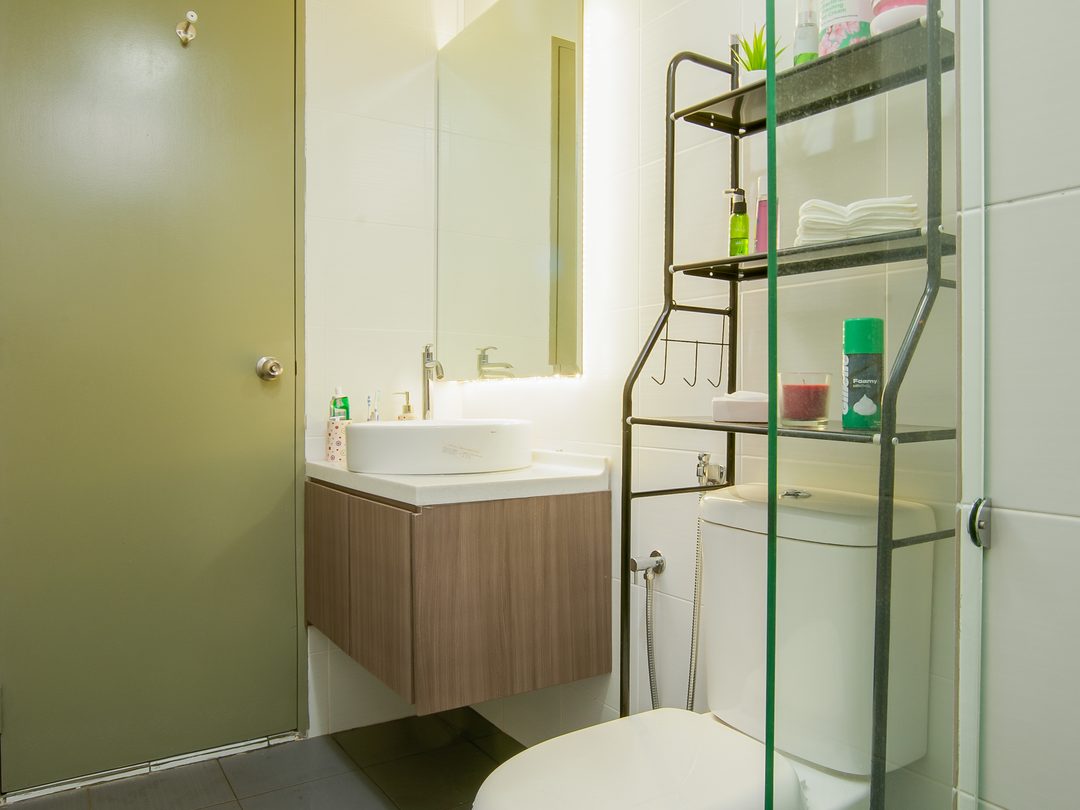
- Kitchens and bathrooms are fixed-cost rooms, not proportional ones. A sink, a hob, a shower set and a waterproofing membrane cost roughly the same whether the room is 40 sq ft or 70 sq ft, and one Klang Valley report puts kitchen and bathroom work at 35 to 50 percent of a typical project. Spread those fixed costs over a small floor and the per-square-foot number jumps, even though the ringgit total is unremarkable. That's why a compact condo bathroom can show a higher psf than a spacious bungalow bathroom while costing less overall.
- Carpentry is priced per foot run, not per square foot of floor. A long, continuous run of cabinets and an L-shaped layout in the same floor area don't cost the same, because carpentry is billed by the length of cabinet, not the size of the room it stands in.
- A small unit concentrates its built-ins. People in compact apartments often want more storage per square foot, not less, because there's no spare floor for a free-standing wardrobe. More carpentry per square foot means a higher blended psf, for a unit that in ringgit terms is one of the cheaper renovations a contractor will do all year.
None of this means renovation is priced unfairly. It means a single per-square-foot figure is an average of very different room-level costs, and averages hide the one thing you actually want to know: what's inside this particular quote.
What ambushes people who shop by psf alone
Knowing why the figures disagree protects you from four common mistakes.
Comparing psf across two guides as if they measured the same thing. They surveyed different projects, in different states, at different points in a period of shifting material costs. A figure from a Penang guide and a figure from a Klang Valley guide aren't describing the same market.
Assuming a low-psf quote and a high-psf quote for the same house describe the same job. They rarely do. The cheaper number usually excludes something: the existing wiring stays, the floor stays, disposal isn't itemised. Compare scope first, psf second.
Expecting the 6% service tax on construction to land on a home renovation. Since 1 July 2025, Malaysia's expanded service tax has charged 6% on construction work services, but construction work for residential buildings, and the public facilities that go with them, is excluded, and so is renovation and interior design for residential houses. If a contractor tells you service tax now applies to your home renovation, check before you accept it, because for a residential contract it generally doesn't.
Treating psf as a ceiling instead of a sanity check. A quote far outside the published ranges, in either direction, is worth a calm question. It doesn't automatically mean the number is wrong.
How to actually use the number
So keep the per-square-foot figure, but put it to work in the right order.
- Ask for the scope before the psf. What's being kept, what's being hacked out, what's included in "kitchen" and what's billed separately.
- Ask for carpentry in feet run, with the board and hardware named. This is where psf distortion concentrates, so this is where the real comparison happens.
- Compare the ringgit total for a matched scope, not the psf for a mismatched one. Two contractors pricing the same nine items at the same finish level will land close together in total, even if their psf headlines differ, because floor area was never the real driver.
- Use published ranges as a sense check, not a target. If a number sits far outside every published range, ask why before assuming either the guide or the quote is wrong.
- Get a site visit before trusting any number, yours or ours. Every figure in every guide, this page included, comes from other people's projects. Yours has its own walls.
How we price it, since you asked
We don't quote per square foot, and we explain why in the first meeting. A site visit tells us what's actually inside the walls, and the quote that follows is itemised by trade with the exclusions written down, not blended into one rate per square foot. If the existing wiring can stay, that's in the document. If it can't, the cost of replacing it is in the document too, before anyone signs.
The number you get from us won't always be the lowest you get. It will be the one that still matches the invoice at the end, because it was never built by dividing a lump sum by your floor area in the first place.