Smart home gadgets in Malaysia are cheap and getting cheaper. A Wi-Fi camera costs less than a family dinner, a smart plug costs less than a tank of petrol, and every 11.11 and 12.12 sale pushes prices lower. What doesn't get cheaper is the wiring behind them. Whether that RM120 camera records reliably, whether a smart switch flickers, and whether the Wi-Fi reaches your aircon upstairs are all decided by cables, sockets and switch boxes, and those are cheapest to get right while your walls and ceilings are open.
This guide covers what's actually on sale in Malaysia, what it costs, and what to plan into a renovation so it works. Prices were checked on 2 November 2026 from official stores, retailers and dated Malaysian buying guides. Treat them as a guide: they move every week, and mega-sale prices are usually well below them.
What a smart home looks like in Malaysia in 2026
For most Malaysian homes, a smart home isn't a talking speaker that runs the house. It's a handful of practical devices you control from your phone: cameras at the gate and in the living room, a video doorbell, a digital lock, smart plugs, and aircons you can switch on before you get home. TP-Link's Tapo and Xiaomi are the most widely sold and reviewed brands, on Shopee, on Lazada and at retailers like Harvey Norman and Senheng. Their apps are what most people end up using day to day.
The AI assistants in the headlines haven't arrived yet. Google's Gemini for Home is in early access in 20 countries and Malaysia isn't one of them, Amazon's Alexa+ isn't available here, and Google's assistant on Nest speakers works in English only, with no Bahasa Melayu. The AI you can actually buy in Malaysia is built into the products themselves: person detection on cameras, and energy modes on some aircons, such as Samsung's AI Energy Mode, which Samsung claims cuts energy use by up to 30%.
What things cost
| Device | Typical price in Malaysia | Examples |
|---|---|---|
| Indoor Wi-Fi camera | RM70–250 | Tapo C210 RM120 (Harvey Norman), Xiaomi C300 RM129 on sale |
| Outdoor Wi-Fi camera | RM150–420 | Tapo C500 RM149, Tapo C530WS RM249 |
| Video doorbell | RM199–399 | Tapo D210 RM249, D230S1 RM349, D235 RM399 |
| Digital door lock | RM1,100–2,900, plus RM250–600 to install | Aqara, Philips, Igloohome; grille locks cost more |
| Smart plug | RM29–49 | Tapo P100 RM29–35, IKEA GRILLPLATS RM39 |
| Smart hub or speaker | RM190–650 | Google Nest Mini RM189–219, IKEA DIRIGERA RM399, Apple HomePod mini RM649 |
| Smart remote for an existing aircon | RM47–184 | Tuya IR hub RM47, Broadlink RM4 Mini RM89.99 |
| Wi-Fi aircon, 1.0hp inverter | from about RM1,870 | Daikin FTKF (Wi-Fi built in) |
| App-controlled ceiling fan | about RM990–1,170 | KDK Nodoka |
| Robot vacuum | RM449 to RM6,000+ | Xiaomi E5 RM449, Dreame D20 Ultra about RM1,700 |
Prices drop hard during the big online sales. During 11.11 in 2024, for example, a Tapo C200C camera sold for RM46. If you're buying several devices, it's worth waiting for a sale, but plan the wiring now: that part can't wait for a discount.
Cameras: plan the cable and the storage, not just the camera
A budget Wi-Fi camera does a good job, but it needs three things the camera can't supply. The first is a power point at every camera position, outside as well as in, ideally under an eave and about two metres up so it catches faces. The second is a strong 2.4 GHz Wi-Fi signal there, because many budget models, such as the Tapo C225, don't use 5 GHz at all. The third is somewhere to keep the footage.
On storage, a microSD card in the camera (up to 512 GB on current Tapo models) costs nothing after you buy the card. Cloud plans cost roughly RM10–17 per camera per month for Tapo Care, and TP-Link now shows its Malaysian prices only in the app. Across three or four cameras, cloud can cost more each year than the cameras did. A sensible middle ground is local storage for indoor cameras and cloud only for the one at the gate, because a thief can take an outdoor camera, card and all.
For a landed home, the most reliable option is a wired camera on a network cable (Cat6), which carries both power and data over one line, known as PoE. Running that cable to the gate pillar, car porch and back lane costs very little while the walls are open, and a great deal more to retrofit later. A wired system with a recorder also needs a small UPS, or it stops recording when the power goes off.
One legal point: cameras for purely personal and household use generally fall outside Malaysia's data protection law (PDPA), but neighbour disputes are another matter. In Lew Cher Phow v Pua Yong Yong (Johor High Court, 2011), a homeowner was ordered to remove a camera aimed into a neighbour's courtyard and porch. Point cameras at your own gate, porch and doors, use the privacy-mask setting where a view crosses next door, and in a condo check the management's rules before fitting anything that faces a shared corridor.
Doorbells and digital locks: condos and landed homes need different setups
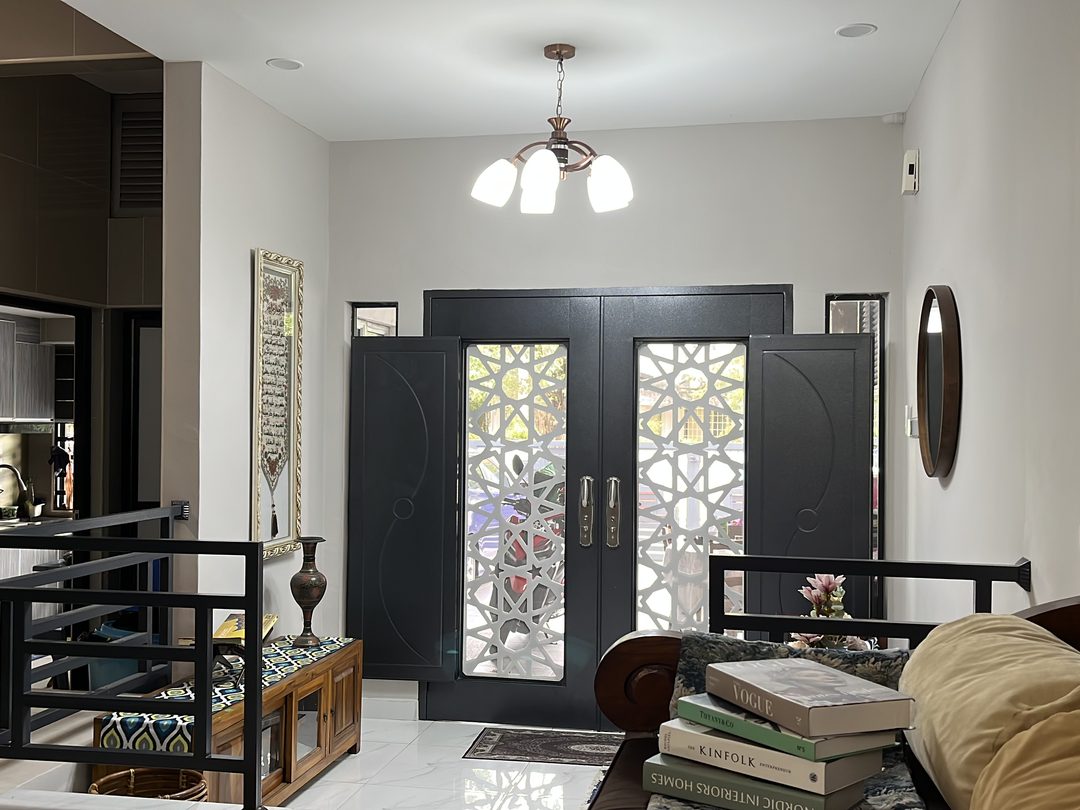
In a condo, a battery video doorbell and a digital lock on the main door are usually all you need, and neither needs new wiring. Tapo's D230S1 runs on a removable battery, though its chime hub needs an indoor power point.
Landed homes are different, because the front door is often behind a grille and the gate is several metres away. Grille locks are their own category (the Philips 515K, for example, at about RM1,488–1,538), and installation costs more on grille, glass or sliding doors: around RM350–550, against RM250–350 for a standard door. If you want a doorbell or intercom at the gate, plan a power or low-voltage feed to the gate pillar during the renovation. Tapo's D235 is the only Tapo doorbell that can be hardwired. Whatever lock you choose, keep a physical key: batteries run out, and so do apps.
Lighting and switches: the wire that decides everything
This is the single most useful thing to know before you renovate. Malaysian switch boxes usually carry only the live and switched-live wires, with no neutral; the neutral stops at the socket, following British wiring practice. Most smart wall switches need a neutral. "No-neutral" versions exist, but they pass a small current through the lamp, can make LED lights flicker, and handle less load. When your home is being rewired, ask for a neutral to be run to every light and fan switch box, and for slightly deeper back boxes, since smart switch modules are bulkier. It adds very little to a rewire, and it's difficult to add once the walls are plastered.
Two buying cautions. Switches, sockets and plugs are regulated electrical equipment in Malaysia and need Energy Commission approval and the SIRIM label, so check for both rather than buying the cheapest glass panel online. Many of those panels are 86 mm "EU type" designs, which may not fit a standard UK-type back box. Ask your electrician before you buy.
If you'd rather not touch the wiring at all, smart bulbs and plugs are the easy route. IKEA Malaysia's range is a good example, with clear prices: the DIRIGERA hub is RM399, the GRILLPLATS smart plug RM39, and a motion sensor RM29. If you want smart LED strips inside cabinets or wardrobes, they run through a small driver (IKEA's TRÅDFRI driver is RM60), so plan a socket inside the joinery at the carpentry drawing stage.
You'll see "Matter" on more boxes. It's a standard that lets a device work with Apple Home, Google Home, Alexa and Samsung SmartThings instead of locking you into one brand's app. IKEA's newest plugs, remotes and sensors carry it. It's worth preferring when the price is similar, but most of what Malaysians buy today still runs on the brand's own app, and that works fine.
Aircons and fans: where smart control actually saves money
Aircon is where a smart home pays for itself, but only by cutting the hours it runs. App control doesn't make the compressor more efficient. Many current models have Wi-Fi built in: Daikin's current series, for example, from about RM1,870 for a 1.0hp inverter. Others need an add-on adaptor: Panasonic's premium series need one at RM265 per unit. Ask which series your quotation includes, because the adaptor adds up across five or six units.
For an existing aircon, a smart remote (an infrared hub that copies your remote control) is the cheapest route, from RM47 for a Tuya hub or RM89.99 for a Broadlink RM4 Mini. One Malaysian estimate puts the saving from avoiding one hour a day on a 1.5hp unit at about RM5 a month, so a RM47 hub pays for itself in under a year. It needs a socket nearby and a clear line of sight to the aircon.
Three energy changes, and one rebate, make this a good time to rethink how your home cools:
- TNB's tariff since July 2025 works out to about 44 sen per kWh for most households, before the monthly fuel adjustment.
- The optional Time-of-Use tariff makes weekday power cheaper outside the 2pm–10pm peak. It needs a smart meter and is applied for in the myTNB app, and it only pays off if you can move heavy use, such as laundry and water heating, out of the peak.
- A stricter aircon star label applies to units certified from 1 January 2026, and old and new labels are on sale side by side. Check that the label says 2026.
- SEDA's NUR:DOMESTIK 2026 rebate takes up to RM200 off a 4- or 5-star aircon or fridge bought in 2026, at the till. It's one rebate per domestic electricity account, for Malaysian citizens, and not for accounts that already claimed in 2025. You can claim it at registered retailers or through their stores on Shopee, Lazada, TikTok Shop, PGMall and Youbeli. It has a quota and is first come, first served, so check your eligibility on SEDA's site before you shop.
For fans, KDK makes an app-controlled ceiling fan (the Nodoka, listed at RM1,170), but a good DC ceiling fan with a remote costs around RM370–410 and covers most of the benefit. Whichever you choose, the fan point, a properly fixed ceiling hook and the switch wiring are set before the plaster ceiling goes up.
The renovation checklist for a smart-ready home
Everything above comes down to a short list to settle with your designer and electrician before work starts. Your electrician should confirm each electrical item for your home.
| Plan this during renovation | Why |
|---|---|
| A neutral wire to every light and fan switch box, and deeper back boxes | Lets you fit proper smart switches now or later, without flicker |
| Cat6 cable to each outdoor camera position and the gate | Reliable wired cameras with power and data on one cable |
| A weatherproof power point at each Wi-Fi camera position | Wi-Fi cameras still need power, and an extension cord outside isn't safe |
| Power or low-voltage feed to the gate pillar | For a gate doorbell, intercom or autogate |
| Cat6 to the TV, study and a ceiling point on each floor for Wi-Fi | Wi-Fi that reaches upstairs aircons, cameras and bulbs, especially in double-storey homes |
| A small ventilated cabinet near the fibre box, with sockets and a UPS | Router, network switch and recorder in one place, still running in a power cut |
| A socket inside each curtain box | Motorised curtains need power above the window |
| A socket inside joinery for cabinet and wardrobe LEDs | Smart LED strips run through a driver that sits inside |
| A socket near each aircon for a smart remote, if the aircon isn't Wi-Fi | Infrared needs line of sight and power |
| A floor socket in a utility corner for a robot vacuum dock | Docks need a permanent home and power |
| Door and grille chosen with the digital lock | Grille and sliding doors limit which locks fit, and cost more to install |
Before you hand over the keys to your own home. Change every default password, turn on two-factor login in each app, and put smart devices on a separate guest Wi-Fi network if your router allows it. In 2014, Malay Mail reported hundreds of Malaysian camera feeds streaming publicly online because their default logins were never changed. It takes ten minutes to avoid.
The gadgets will keep changing, and next year's models will be cheaper and smarter. The wiring you put in during a renovation stays for the life of the house. Get the neutral wires, network cable and sockets in while the walls are open, and you can buy the devices whenever the price is right. If you're planning a renovation, our renovation service covers the electrical work alongside everything else, so the smart home is part of the plan from the first drawing, not an afterthought.