The keys are not the starting gun
You collected the keys, walked the empty rooms, and started picking wall colours in your head. That is the fun part, and it is also the part that gets people into trouble, because the order you renovate in matters more than the finishes you pick.
Before a single contractor quotes, two things come first. You claim what the developer already owes you, and you decide the sequence of work. Neither is glamorous. Both are worth more ringgit than any price you will haggle down later.
First, before any renovation: claim your defects
A new home comes with a warranty most first buyers underuse. Under the Housing Development (Control and Licensing) Act 1966 and its Schedules G and H, the developer must repair defects at no cost to you for 24 calendar months from the date of vacant possession, the date on the notice you signed to collect the keys. Cracked tiles, a leaking tap, a door that will not shut, uneven plaster: all of it is theirs to fix while the clock runs.
So inspect before you renovate, not after. Go room by room. Test every socket, run every tap, open every window, and photograph everything with a date. Submit the defect list in writing, and the developer is expected to make good within about 30 days.
The reason this comes first is money. Hack a wall or lay new tiles over a developer defect, and you have quietly taken on a repair that was free, and made it far harder to prove the fault was theirs and not caused by your renovation. Claim first. Renovate second.
The order that actually saves money
Once defects are logged and approvals are in hand, the sequence is not a matter of taste. It follows one rule: buried and permanent first, visible and reversible last. The deeper a thing sits, the more it costs to reach again, so it goes to the front.
| Stage | What it is | Why it goes here |
|---|---|---|
| 1. Defects and approvals | Inspect, file the DLP claim, get strata or council sign-off | Free repairs expire, and work without approval gets stopped |
| 2. Wet works and waterproofing | Bathrooms, kitchen floor, any hacking | Buried under tile, so redoing it means demolition |
| 3. Electrical and plumbing | Power points, wiring, water points, aircon trunking | Chased into walls, so moving one point later cracks a finished wall |
| 4. Carpentry | Kitchen, wardrobes, TV console, feature walls | Fixed and measured to the room, and the single biggest cost |
| 5. Paint and ceiling | Plaster ceiling, skim coat, paint | Cheap and fast, done after the dusty trades finish |
| 6. Finishes | Lighting, curtains, furniture | Reversible, and the easiest to change your mind on |
These are indicative market ranges, not a quote. They are compiled from Malaysian renovation cost guides published in 2026 and listed at the bottom of this page. A real number needs a site visit, because it depends on what is already inside your walls. Plan your renovation and we will give you a scoped figure instead of a range.
Do it in this order and each trade builds on a finished layer below it. Do it out of order, and you pay to break something you already paid for. Painting a room, then hacking the wall two months later to run aircon trunking, is the most common version of that mistake.
Where the money goes in a new unit
A new developer unit is different from an old house, and it changes what you spend on first. The developer already tiled the floors, waterproofed the bathrooms and painted the walls, so wet works, the biggest surprise in an old-house renovation, are mostly done. What is left is fit-out, and fit-out is carpentry.
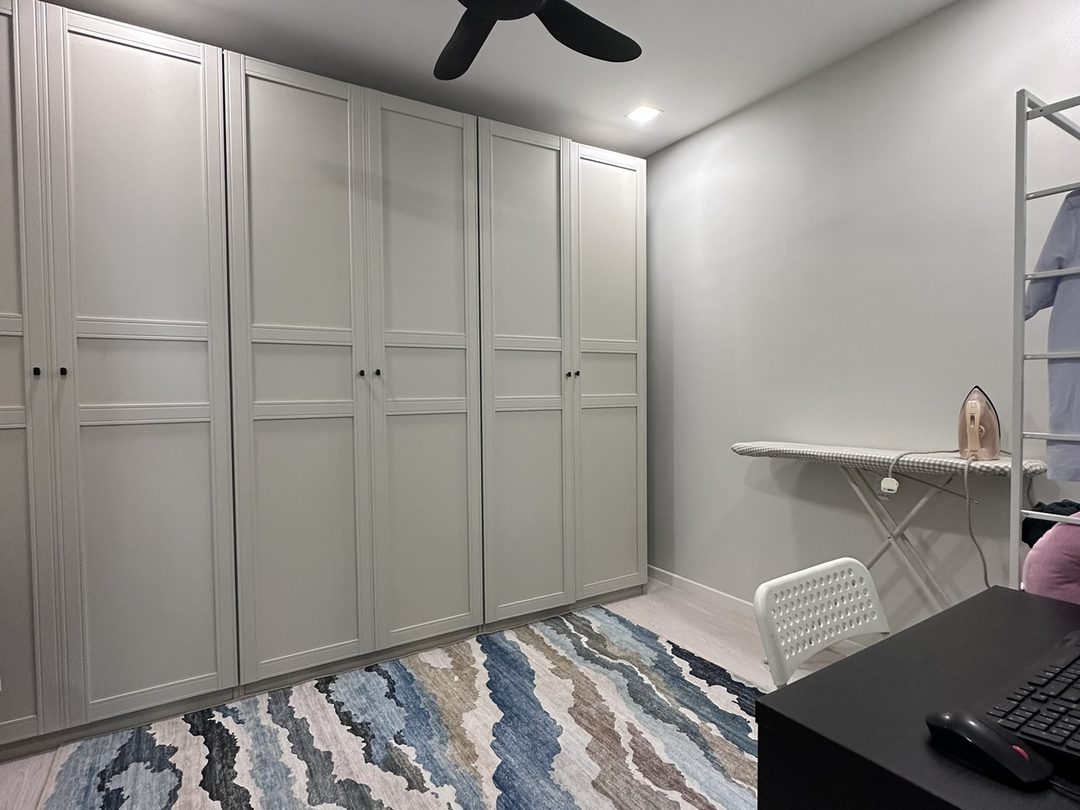
Carpentry is priced per foot run, not per room. Published 2026 Klang Valley guides put built-in wardrobes around RM350 to RM900 per foot run, and a kitchen from roughly RM8,000 for a basic layout to RM35,000 for a mid-range one, before appliances. Whole-job, standard renovation work lands around RM90 to RM160 per square foot. Those are the lines that decide your first-year budget, which is why carpentry choices deserve the most thought and the paint colour the least.
Hold back 10 to 15 percent of the total as a contingency, and treat it as untouchable. Even in a new unit, something moves: a socket in the wrong place, an aircon point the developer never ran, a wardrobe that has to work around a low beam.
Why the order shifts if the house is not new
The sequence above assumes a new unit with a valid CCC. Change the property and the front of the queue changes with it.
- Sub-sale or older homes put wet works and rewiring back at the top. The waterproofing may have failed, the wiring may not carry an induction hob and two air-conditioners, and none of that is visible on viewing day. Here the renovation cost pillar applies in full, because you are renovating, not just fitting out. If the property is decades old or inherited, see our full old and inherited house renovation checklist for what to check before the design brief even starts.
- Strata versus landed changes the approvals stage. A condo needs written management approval and a refundable deposit before any work, commonly RM1,000 to RM5,000, under the Strata Management Act 2013. A landed home needs council approval only if you hack a structural wall, extend the footprint or change the facade, and that can take two to six weeks. Our approvals guide walks through which office you actually deal with.
What ambushes first home buyers
- Renovating before filing defects. The most expensive rookie move, and the easiest to avoid. Inspect, claim, then touch nothing until the developer has been.
- Skipping strata approval. Management can stop your job mid-week and withhold the deposit. The approval is slower to get than the fine is to receive.
- Finishes before services. Curtains and a feature wall feel like progress. They are the last stage, not the first, and doing them early means redoing them after the aircon and wiring go in.
- Buying furniture too soon. Carpentry is measured to the room. Buy the sofa before the built-ins are drawn and you will be designing the wall around the sofa, which is backwards.
- Spending the whole budget in year one. You do not have to finish everything at once. Some rooms genuinely reveal what they need only after you have lived in them.
How to judge what to do now and what can wait
One rule of thumb settles most of it. If a thing sits behind a wall, under a tile, or needs the whole house empty and full of dust, do it now, while the unit is bare and cheap to work in. If it is reversible and cosmetic, it can wait until you have lived in the space and know how you actually use it.
Living in a home for a few months teaches you things a floor plan cannot: where the light falls in the afternoon, which corner collects clutter, whether you ever use the second bathroom. Storage, lighting and layout decisions made after that knowledge are better decisions. There is no prize for finishing fast, and a phased plan spreads the cost besides.
How we work, since you asked
We design first, then sequence the trades so each one builds on the last, and the same studio that draws it is the one that builds it, so nothing is lost between the drawing and the site. For a first home that means we start with what is permanent and expensive to undo, and leave the reversible, changeable things for when you know the house. You can see the full sequence in our interior design process guide, or read how the design-and-build model keeps one team accountable from first sketch to handover.
The plan you get from us puts the money where a first home actually needs it, in the order that means you only pay for each thing once.
Sources
Renovation cost ranges on this page are drawn from Malaysian renovation cost guides published in 2026, including the ClickBina Klang Valley renovation cost report 2026. The defect liability period, its 24-month duration and the vacant possession process are set out in the Housing Development (Control and Licensing) Act 1966 and its regulations, summarised for homeowners by ClickBina, Far Capital and PropertyGuru Malaysia. The strata approval requirement is set by the Strata Management Act 2013, summarised by PropertyGuru. Ranges vary between sources and none of them is a substitute for a scoped quote on your own property.
Read next: What actually happens in an interior design and renovation project · design and build · kitchen renovation