Two different jobs wearing one name
"Ceiling work" on a renovation quote can mean two entirely different things, and mixing them up is how a bedroom ends up with an unnecessary RM20-per-square-foot feature ceiling, or a kitchen ends up with visible aircon trunking because nobody built the void to hide it.
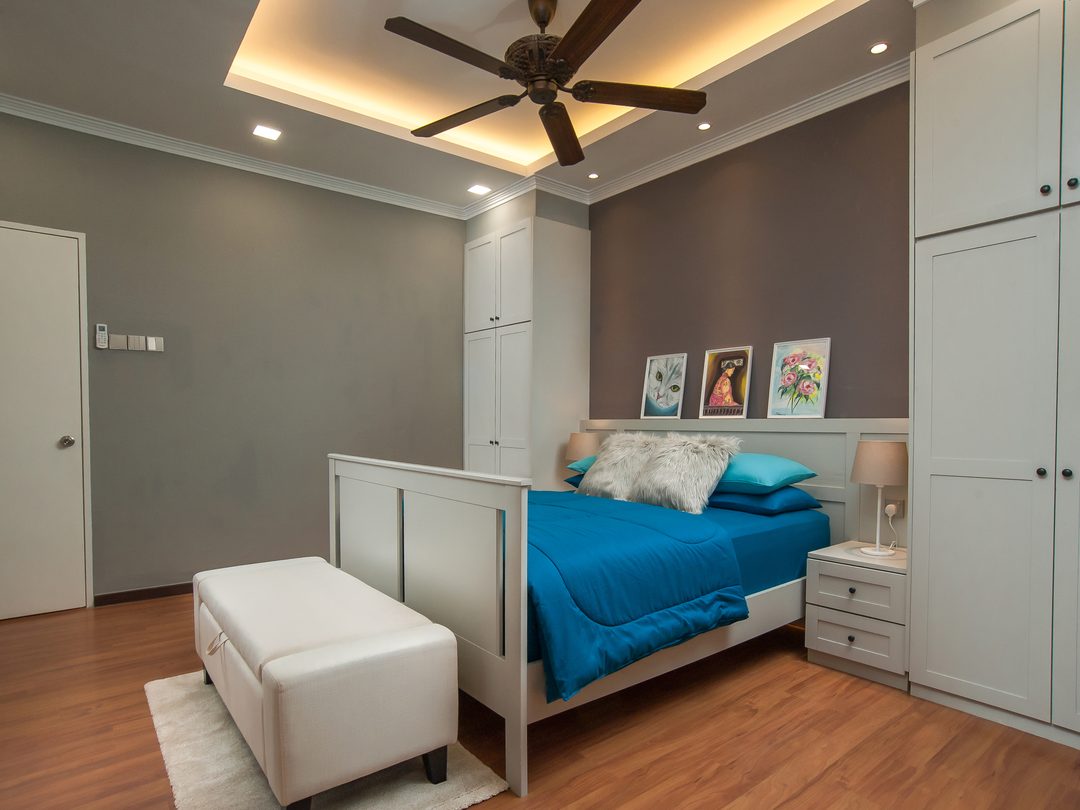
A plaster ceiling is a false ceiling, gypsum board fixed to a metal frame suspended below the actual concrete slab, creating a real void between the two. That void is what conceals wiring, air-conditioning ducts and refrigerant pipes, and it is what makes recessed downlights, cove lighting and multi-level ceiling designs possible.
A skim coat is a thin, fine mortar finish, roughly 2 to 3mm, trowelled directly onto the existing ceiling surface to smooth out imperfections before painting. There is no void, no concealment, no new lighting geometry. It is a surface refinish, not a new structure.
When you actually need a plaster ceiling
- Concealing aircon trunking and wiring. Ducted air-conditioning, refrigerant lines and their insulation need a real cavity to run through. A skim coat sits flush on the slab and cannot hide anything behind it.
- Recessed and cove lighting. Downlights need a void to sit in. Cove lighting, a recessed channel that hides an LED strip for indirect illumination, is one of the most requested ceiling features in Malaysian homes today, and it only exists inside a plaster ceiling's void.
- Levelling a badly uneven slab. Where the concrete soffit itself is too uneven for a skim coat to correct economically, a suspended ceiling resets the surface from scratch.
- A cornice or feature ceiling as part of the design language. Fibrous plaster cornicing, the moulded strip at the wall-ceiling junction, is still widely specified in Malaysian homes, especially classical, colonial or traditional interiors, and needs the same suspended structure to install cleanly.
2026 cost per square foot
| Ceiling work | Price (2026) | What drives the cost |
|---|---|---|
| Skim coat | Roughly RM1.50 to RM2 per sq ft for the coating itself | Surface condition, number of coats needed |
| Basic flat plaster ceiling | Roughly RM5.50 to RM8 per sq ft (some quotes RM3.50 to RM6 for thinner 6mm board) | Board thickness, ceiling height, access |
| False ceiling with moderate features | Roughly RM8 to RM14 per sq ft | Number of lighting points, minor steps or bulkheads |
| Cove lighting / L-box | Roughly RM15 to RM25 per foot run | Length of the light trough, number of corners |
| Complex or coffered feature ceiling | Roughly RM20 to RM30+ per sq ft | Multi-level design, curved sections, integrated lighting |
These are indicative market ranges, not a quote. They are compiled from Malaysian sources published in 2026 and listed at the bottom of this page. Plan your renovation and we will give you a scoped figure instead of a range.
The jump from a basic flat plaster ceiling to a feature ceiling with cove lighting is not incremental, it can be three to five times the cost per square foot once lighting troughs and multi-level detailing come in. That is worth knowing before a "ceiling upgrade" line item on a quote turns out to include a full coffered design nobody explicitly asked for.
Why plaster ceilings crack or develop damp patches here
Moisture, not structural settling, is the main cause of ceiling cracks and staining in Malaysian homes. The most common specific culprit is condensation inside the ceiling void from air-conditioning trunking. If the pipe insulation is too thin or the joint seams are not properly taped, warm humid air trapped in the ceiling void condenses against the cold refrigerant copper. Over weeks that water saturates the insulation and eventually drips continuously onto the plaster below, producing the yellow-brown staining and bubbling paint that homeowners often mistake for a roof leak. Left unaddressed, a blocked aircon condensate drain does the same thing from a different source, and either one turns a small maintenance fix into ceiling repair costs that climb quickly once mould and electrical risk near wiring enter the picture.
The practical takeaway: a plaster ceiling is only as good as the aircon insulation installed above it. Ask specifically whether the ducting insulation and joint sealing are part of the ceiling scope, not assumed to already be adequate.
Gypsum board vs calcium silicate board: the outdoor exception
Most Malaysian plaster ceilings use gypsum board, which is light, easy to install and the cheaper of the two, and it is the right choice for any internal, air-conditioned room. It is also the more moisture-sensitive of the two: sustained humidity or a leak above it can lead to warping or mould, which is exactly the aircon-condensation failure described above.
Calcium silicate board is the answer for ceilings that sit outside the air-conditioned envelope, a car porch, a service yard, an exterior soffit or a semi-outdoor patio roof. It resists swelling, warping and rot under sustained humidity and temperature swings far better than gypsum, and while it is not fully waterproof under continuous standing water, it tolerates the kind of humidity exposure that would eventually degrade a gypsum ceiling. It costs more and is harder to cut and install, generating more dust on site, which is why it is specified selectively rather than used throughout a home. The practical rule: gypsum board indoors, calcium silicate board anywhere the ceiling is exposed to the outside air.
When skim coat and a good paint job is the honest answer
Not every room needs a false ceiling. If there is no ductwork to hide, no cove lighting in the design, and the existing slab is structurally sound and reasonably level, a skim coat followed by a proper washable emulsion gets a clean, paintable surface for a fraction of the cost. Bedrooms without ducted air-conditioning, store rooms, and utility spaces are the obvious candidates. The honest question to ask before agreeing to a plaster ceiling upgrade is simple: what is it actually concealing, or what lighting effect does it enable, that a skim coat cannot? If the answer is "nothing, it just looks more finished," that is a design preference worth pricing consciously, not a technical requirement. A skim coat paired with the right paint sheen (see our 2026 paint colour guide for sheen recommendations by room) is a legitimate, durable finish on its own.
Either way, the ceiling decision belongs early in a full renovation scope, since it determines where wiring, aircon lines and lighting points can physically run.
Sources
Plaster ceiling and false ceiling pricing for 2026 is drawn from Plaster Ceiling's 2026 price guide, Recommend.my's plaster ceiling price calculator, and ClickBina's false ceiling cost guide. The technical distinction between plastering and skim coating is from Sika Malaysia and Unitrade's skim coat guide. Cornice and cove lighting context for Malaysian interiors is from Industrial Malaysia's plaster ceiling guide. Aircon condensation and ceiling damp causes are from Ban Leng Air Cond and Plaster Ceiling's cracked ceiling repair guide. Gypsum versus calcium silicate board performance is from New Element Group's comparison guide and Prance Building's board comparison. Ranges vary between sources and none replaces a scoped quote for a specific ceiling.
Read next: Which renovation materials survive a Malaysian home · Quartz vs sintered stone for a Malaysian kitchen · Paint colours for Malaysian homes in 2026 · renovation